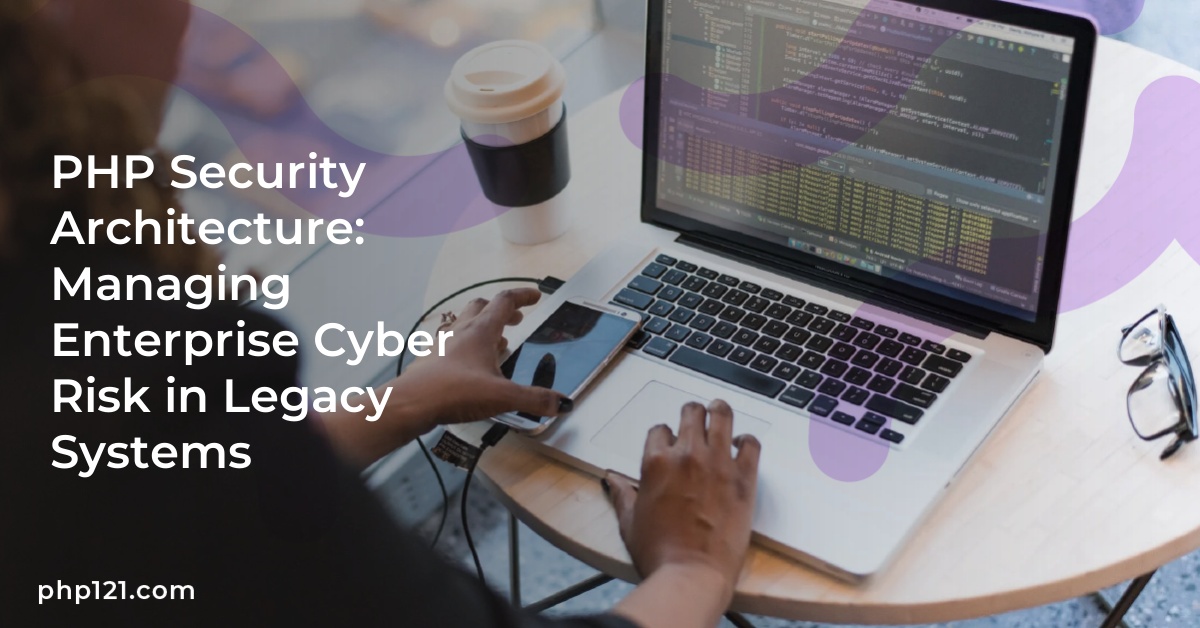
You inherited a PHP 7.2 application running on a production server, it handles customer payment data, and the last security review was three years ago. That’s not a hypothetical — it’s the reality for a large share of enterprise PHP teams right now. This guide gives you a concrete, PHP-specific strategy for identifying your highest-risk vulnerabilities, implementing security controls incrementally, and reducing your actual attack surface without shutting down the system to rewrite it.
Quick Definition: PHP security architecture for legacy systems is the practice of layering modern security controls — input validation, prepared statements, centralized authentication, and dependency management — onto existing PHP codebases that weren’t originally built with those patterns, without requiring a full application rewrite or framework migration.
Why Legacy PHP Systems Carry Outsized Enterprise Risk
PHP 7.4 reached end-of-life in November 2022. PHP 8.0 followed in November 2023. Any application still running on those versions receives zero security patches from the PHP core team, meaning every CVE disclosed after those dates sits permanently unaddressed in your production environment. PHP 5.6 systems, and yes, they still exist in enterprise environments — have been without official patches since December 2018.
The risk compounds quickly in enterprise contexts. Managing enterprise cyber risk in legacy PHP applications means acknowledging that there’s no middleware pipeline, no ORM enforcing parameterized queries, and no centralized input validation layer. Raw $_GET and $_POST values flow directly into database queries and HTML output. That’s the root cause of SQL injection and XSS vulnerabilities across the OWASP Top 10, and it’s endemic to codebases written before PHP 5.5.
A Forrester survey found that only 21% of IT decision-makers reported having no significant tech debt, meaning 79% of organizations carry moderate to high levels of accumulated technology debt. Legacy PHP systems sit squarely in that category. When those systems integrate with sensitive data stores, internal APIs, and compliance-regulated workflows (PCI-DSS for payment data, HIPAA for health records, SOC 2 for enterprise SaaS), the exposure extends well beyond a single application vulnerability.
The question isn’t whether your legacy PHP system has security gaps. It almost certainly does. The question is which gaps to close first and how to do it without breaking the application your business depends on today.
Mapping the Attack Surface Before Writing Security Code
You can’t prioritize what you haven’t inventoried. Before implementing any security control, map every point where external data enters your application.
Identify All Entry Points
Your attack surface includes more than HTTP form submissions. Build a complete inventory:
- HTTP endpoints accepting GET and POST parameters
- File upload handlers and their destination directories
- CLI scripts and cron jobs that accept arguments or read from external sources
- API consumers receiving data from third-party services or internal microservices
- Cookie and session data used in application logic
Every item on that list is a potential injection vector. Legacy PHP codebases frequently have CLI scripts and cron jobs that bypass the same validation logic applied to web requests (attackers who can influence those inputs get a different attack path entirely).
Audit Dependencies and Classify Data Flows
Run composer audit immediately. This command cross-references your installed packages against the PHP Security Advisories database and outputs a list of packages with known CVEs. Add Roave/SecurityAdvisories to your composer.json as a dev dependency — it prevents Composer from installing packages with known vulnerabilities entirely. This takes five minutes and gives you an immediate, prioritized list of dependency risk.
After the dependency audit, map your data flows. Trace where credentials, PII, and payment information enter the system, which functions process them, and where they exit — into the database, into API responses, into log files. This classification tells you which vulnerabilities carry the highest business impact if exploited. Use PHPStan or Psalm to surface type-unsafe code paths; both tools identify locations where unvalidated external data reaches sensitive operations, which are your highest-priority injection vectors.
The Four Highest-Priority Security Controls
How do you prioritize security risks in a legacy PHP application? Work through these four controls in order — each one closes a distinct vulnerability class that attackers actively exploit in legacy PHP systems.
- Fix input validation and output encoding first. SQL injection and XSS are the top two OWASP vulnerability categories in legacy PHP, and both trace back to the same root cause: unvalidated input reaching sensitive operations. Replace raw
$_GETand$_POSTaccess withfilter_input()and wrap all output that reaches HTML withhtmlspecialchars(). You don’t need to rewrite your controllers to do this — a centralized wrapper function handles it in place. - Replace raw queries with prepared statements. Any codebase still using
mysql_query()(removed in PHP 7.0) or unsanitizedmysqli_query()calls is one malformed input away from full database exposure. Migrate to PDO with prepared statements. The PDO layer separates SQL structure from user-supplied data at the driver level, eliminating the injection vector entirely rather than trying to sanitize around it. - Centralize error handling. Legacy PHP applications that output stack traces, database error messages, or file paths in HTTP responses give attackers a reconnaissance map of your system architecture. Set
display_errors = Offandlog_errors = Oninphp.inifor production. Route all errors to a structured log that your team can monitor without exposing internals to the browser. - Harden session configuration. Session fixation and session hijacking are trivially exploitable in older PHP codebases. In
php.ini, setsession.cookie_httponly = 1,session.cookie_secure = 1, andsession.use_strict_mode = 1. Callsession_regenerate_id(true)on every successful login to invalidate the pre-authentication session ID. These three configuration changes close the most common session attack vectors without touching your application code.
Retrofitting Authentication and Access Control
What’s the biggest security risk in legacy PHP applications? Weak authentication is a strong candidate. Any system storing passwords with MD5 or SHA1 — both of which were common in PHP applications built before 2013 — is one breach away from full credential exposure. MD5 hashes crack in seconds with modern GPU-based tools. The fix is password_hash() with PASSWORD_BCRYPT or PASSWORD_ARGON2ID, and password_verify() for validation. You can migrate existing users incrementally: rehash their password on next successful login without forcing a password reset.
Add Role-Based Access Control Incrementally
You don’t need to rewrite your entire authorization system. Wrap your existing controller logic in a centralized permission check function. Every request that reaches a protected resource passes through a single checkPermission($user, $action, $resource) call. This gives you one place to audit, one place to update, and one place to log access decisions, without restructuring your routing or controller architecture.
Introduce MFA and Token-Based API Auth
For high-privilege accounts, add multi-factor authentication using a library like RobThree/TwoFactorAuth. It implements TOTP (the same standard used by Google Authenticator) and drops into existing session-based auth without requiring an identity platform overhaul. For machine-to-machine API calls, replace session cookie authentication with API keys or JWT tokens. Legacy PHP endpoints that rely on session state for API consumers create fragile, stateful dependencies that are hard to audit and easy to exploit.
Using Modern PHP Tools in a Legacy Codebase
The Symfony Security component installs as a standalone package via Composer. You don’t need a full Symfony application to use its firewall rules, CSRF protection tokens, and voter-based authorization system. This is one of the most practical ways to add a security layer to a legacy PHP application (you get production-tested security primitives without migrating your entire codebase to a framework).
Add PHP-CS-Fixer and PHPStan to your CI pipeline as pre-commit hooks. PHP-CS-Fixer enforces secure coding standards across the codebase automatically. PHPStan catches type-unsafe code paths before they reach production. Neither tool requires changes to your application architecture (they run against your existing code and report violations).
At the infrastructure layer, a Web Application Firewall provides an immediate security perimeter around your legacy PHP application while internal remediation work proceeds. A WAF won’t fix SQL injection in your code, but it blocks common exploit patterns at the network edge and buys your team time to work through the remediation backlog without leaving the application completely exposed.
Managing Dependency and Supply Chain Risk
Legacy PHP applications frequently run packages that haven’t been updated in years. Some of those packages no longer have active maintainers. When a CVE is disclosed in an unmaintained package, there’s no vendor patch coming (your options are to replace the package, fork and patch it internally, or accept the risk with a compensating control).
Pin all dependencies in composer.lock and review the diff on every update. Transitive dependency changes (updates to packages your packages depend on) are a common supply chain risk vector that teams miss when they only review their direct dependencies. Configure Dependabot or Renovate Bot to send automated alerts when new CVEs are disclosed in your dependency tree. Subscribe to the PHP security mailing list for core vulnerability announcements.
When evaluating an unmaintained package, ask whether a maintained alternative exists on Packagist with equivalent functionality. If the package is small enough, forking and patching it internally is often faster than replacing it. Document that decision in your risk register with the CVE identifier, the compensating control in place, and a target remediation date.
Building a Phased Security Remediation Roadmap
A phased approach makes the scope manageable and gives you measurable progress to show stakeholders at each stage.
Phase 1: Stop the Bleeding
Within the first sprint: enforce HTTPS across all endpoints, set secure session configuration in php.ini, disable error output in production responses, and patch the highest-CVSS vulnerabilities identified in your dependency audit. These changes reduce your most immediate exposure and require no architectural changes.
Phase 2: Harden the Perimeter
Implement centralized input validation using filter_input(), replace raw database queries with PDO prepared statements, and add composer audit to your CI pipeline. This phase closes the OWASP Top 10 vulnerability classes that account for the majority of successful attacks against legacy PHP systems.
Phase 3: Modernize Incrementally
Introduce a security middleware layer using the Symfony Security component, upgrade authentication to password_hash() with Argon2id, and begin migrating your highest-risk modules to a supported PHP version. The Strangler Fig pattern works well here: new secure PHP 8.x modules wrap the legacy application gradually, with an API gateway or routing layer redirecting traffic to new components as they’re completed. The old system shrinks over time without a big-bang rewrite.
Document every risk decision explicitly. When a vulnerability can’t be fixed immediately, record the accepted risk, the compensating control in place, and the target remediation date. This documentation is what compliance auditors ask for — it demonstrates that your team has visibility into the risk and a plan to address it, which is often sufficient for PCI-DSS and SOC 2 audit purposes even when the vulnerability remains open.
Communicating Security Risk to Enterprise Stakeholders
CVSS scores don’t move budget decisions. Data breach costs, compliance penalties, and operational downtime do. Frame your security debt in terms of business consequences: what data gets exposed if this vulnerability is exploited, which compliance requirement gets violated, and what the remediation cost looks like compared to the incident response cost.
Present your phased roadmap with clear milestones and measurable risk reduction at each stage. The attack surface map you built during the inventory phase is a useful visual artifact — it shows stakeholders the scope of exposure and lets you demonstrate concrete progress as controls are implemented. A risk register that maps each vulnerability to a CVSS score, affected component, remediation effort estimate, and business impact rating gives decision-makers the information they need to prioritize investment without requiring them to understand PHP internals.
Frequently Asked Questions
How do I secure a legacy PHP application without rewriting it?
Start with configuration changes — session hardening, error suppression, HTTPS enforcement — then layer in input validation and prepared statements. Use the Symfony Security component as a standalone package to add authentication and CSRF protection without a full framework migration.
What are the biggest security risks in old PHP codebases?
SQL injection from unparameterized queries, XSS from unencoded output, session hijacking from weak session configuration, and credential exposure from MD5 or SHA1 password hashing. These map directly to the OWASP Top 10 and are present in most pre-2015 PHP applications.
Which PHP version should I upgrade to first?
Target PHP 8.2 or 8.3 — both are in active support with security patches. PHP 8.1 is in security-only support through December 2025. Anything below 8.0 is end-of-life and receives no patches.
How do I find vulnerable dependencies in my PHP project?
Run composer audit against your composer.lock file. Add Roave/SecurityAdvisories as a dev dependency to block installation of packages with known CVEs. Configure Dependabot to send automated alerts for new vulnerability disclosures in your dependency tree.
Can I use Laravel or Symfony security features in a legacy PHP app?
Yes. The Symfony Security component installs standalone via Composer and works outside a full Symfony application. It gives you firewall rules, CSRF tokens, and voter-based authorization that you can integrate into existing PHP code without migrating your entire application.

Ryan Goose, a seasoned PHP developer and tech enthusiast, brings a wealth of knowledge in web technologies. With a passion for coding and a knack for simplifying complex concepts, Ryan’s articles are a treasure trove for both budding and experienced PHP developers.